
When considering entrusting your home door to a smart lock, even those most captivated by its convenience may harbor two lingering doubts: “What if it runs out of battery? Will I be locked out?” and “Is an electronic lock truly more secure than my sturdy mechanical lock?”
These concerns are completely valid. The answers, however, lie at the very core of modern smart lock design. This article will deconstruct the power system and security architecture of smart locks, replacing speculation with facts and principles, allowing you to confidently embrace smart living.
Part 1: Battery Life – How Long Can Your Smart Lock “Last”?
The primary design principle of a smart lock’s power system is “warning first, backup always.” Its reliability far exceeds common perception.
1. Battery Configuration & Lifespan Benchmarks
Mainstream smart locks primarily use two power schemes:
- Dry Battery Solution (The Mainstream Choice):Typically uses 4 or 8 AA alkaline batteries. Its advantages are mature technology, high stability, and easy availability. Under normal household use frequency (10-15 unlocks per day), battery life generally ranges from 12 to 18 months. Some models with low-power circuit design can even achieve over 24 months.
- Lithium Battery Solution (Integrated Choice):Usually equipped with rechargeable 18650 or similar specification lithium batteries. Lifespan is approximately 6-12 months, requiring periodic charging, but often features a clear battery percentage display for more intuitive management.
Key Insight: Smart locks consume very little power. They spend most of their time in a “deep sleep” state, consuming significant power only during the moments of recognition and motor activation. Standby power consumption is almost negligible.
2. The Multi-Layered, Multi-Stage Low Battery Warning System
You will never face a dead lock without prior warning. A comprehensive alert system includes:
Stage 1: Early Warning (~20% Battery Remaining)
When you bind the lock to your smartphone app, the app will send the first low-battery notification. This is the earliest and most proactive alert.
Stage 2: Active Prompt (~10-15% Battery Remaining)
After each successful unlock, the lock will give a clear audible alert: “Battery low, please replace batteries.” Simultaneously, indicator lights on the panel may flash a specific color (e.g., red).
Stage 3: Final Alert (~5% Battery Remaining)
The voice prompt becomes more frequent and urgent with each use, ensuring every household member receives the message.
3. The “Last Line of Defense” – Emergency Solutions for a Dead Battery
Even if all warnings are missed and the battery depletes completely, you will never be locked out. Modern smart locks come standard with at least one of the following emergency power methods:
Emergency Physical Port (Most Common & Reliable):
Located below or on the side of the exterior panel is a standard USB-C or Micro-USB port. If the lock is inoperative due to a dead battery, simply connect it to any common power bank (portable charger) using a phone cable to provide temporary power and unlock the door normally. This is the most recommended and foolproof emergency solution.
Emergency Mechanical Key (Mandatory by Regulation):
This is a legally required backup. Every smart lock comes with two or more emergency mechanical keys, using a high-security Grade C Lock Cylinder. It is essential to store these in a secure location outside the home, such as your office, a trusted relative’s house, or inside your car.
9V Battery Terminals (Available on Some Models):
Some lock panels have external terminals where a standard 9V battery can be temporarily pressed to provide power.
Important Recommendation:Set “Replace Lock Batteries” as an annual reminder on your family calendar. Replacing all batteries with new ones on a fixed date each year (e.g., New Year’s Day or a family anniversary) can completely eliminate battery anxiety.
Part 2: Security Mechanisms – How Does It Build an Ironclad Defense?
Smart lock security is a trinity of “Physical Defense + Electronic Intelligence + Data Encryption.” It doesn’t replace traditional security but enhances it across multiple dimensions.
1. Physical Security: The Unbreakable “Body”
This is the foundation of security, where smart locks fully meet and often exceed the standards of high-end mechanical locks.
- Lock Body Strength:Made from high-strength alloys, resistant to prying and sawing. The true deadbolt design is crucial—even if the exterior panel is forcibly destroyed, the internal lock cylinder remains securely embedded in the door and cannot be turned.
- Lock Cylinder Grade:Always choose a Grade C Lock Cylinder. This is currently the highest civilian grade, requiring over 270 minutes to resist technical unlocking attempts, far exceeding Grade A (1 minute) and Grade B (5 minutes).
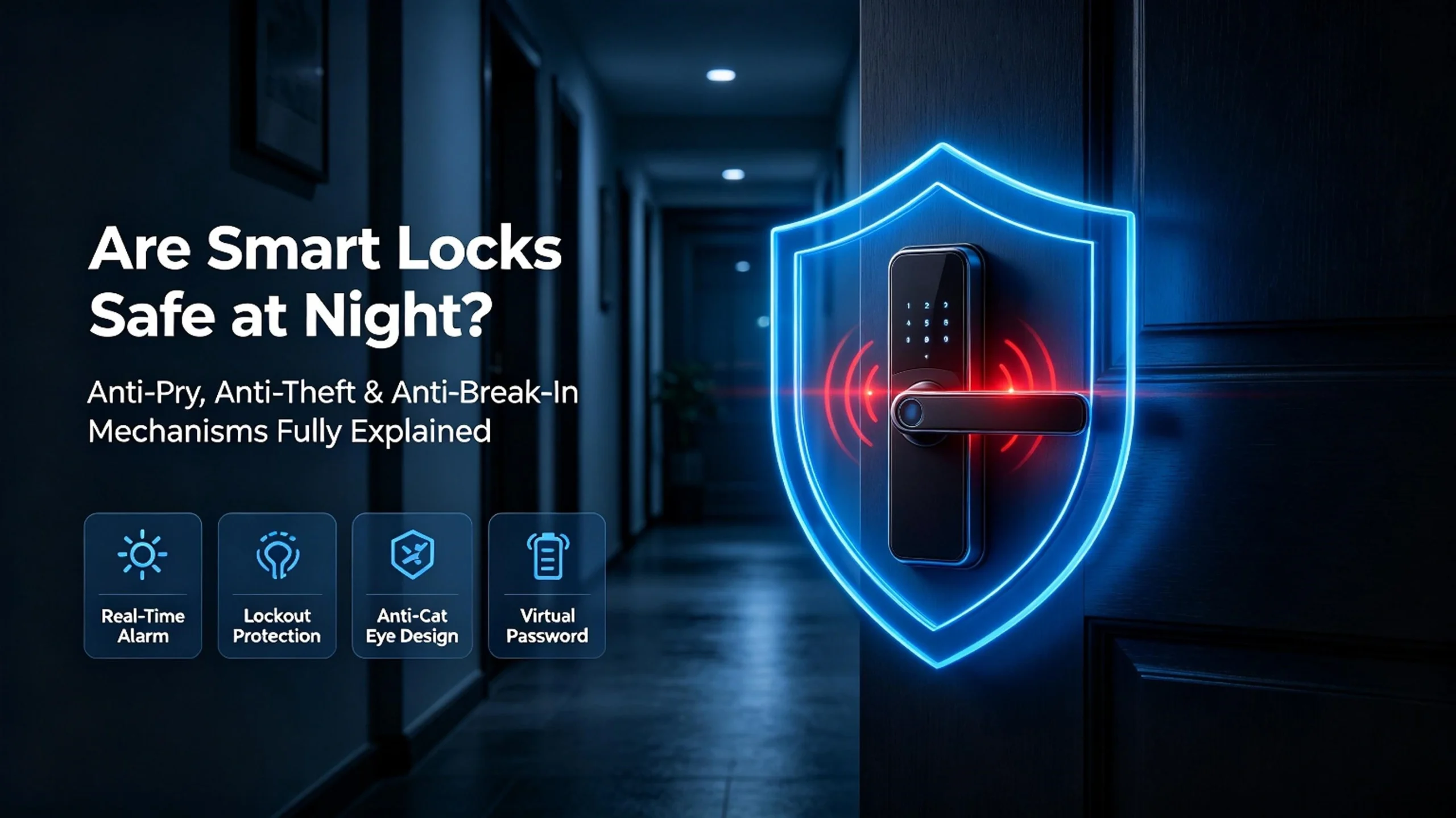
- Tamper Alarm:The lock contains precision sensors. Once an abnormal vibration or prying attempt is detected, it immediately triggers an on-site alarm exceeding 100 decibels and sends a remote alert notification via the app.
2. Electronic & Information Security: The Intelligent, Proactive “Brain”
This is the core advantage where smart locks surpass traditional locks, transforming “passive protection” into “active vigilance.”
- Anti-Electromagnetic Interference (Anti-“Tesla Coil”):Reputable smart locks produced after 2018 have passed electromagnetic interference tests. Their circuit design includes voltage stabilization protection and signal shielding, completely resisting strong electromagnetic pulse attacks (like from Tesla coils), ensuring the circuit cannot be abnormally rebooted or opened.
- Privacy Code (Anti-Snooping):Allows entering random numbers before and after the correct passcode (e.g., entering 456789123450, where only 912345 is the real code), effectively preventing bystanders from memorizing the real password.
- Attempt Lockout & Alarm:After 5 consecutive (configurable) failed attempts using passcode, fingerprint, or card, the lock will automatically lock down for 1-5 minutes and log the event. Simultaneously, the administrator’s phone receives a real-time “Multiple Failed Unlock Attempts” alert.
- Banking-Grade Data Encryption:All critical data like fingerprints and passcodes are not stored plainly but converted locally into irreversible encrypted data strings. Even if the chip is removed, the original biometric information cannot be recovered. Communication (e.g., with the app) also uses dynamic encryption, preventing data interception and cracking.
3. Privacy & Permission Security: The Finely-Tuned “Rules”
- Complete Access Log:Every unlock event—time and method used (fingerprint/ passcode/card)—is clearly logged locally and optionally in the cloud (with user consent), available for review anytime. This is crucial for families with housekeepers, tenants, or those monitoring the comings and goings of elderly relatives or children.
- Time & Space Restricted Permissions:Permissions for temporary users can be finely controlled:
- One-Time Passcode:Expires immediately after use, perfect for a delivery person.
- Scheduled Passcode:For a house cleaner, valid only on Wednesdays from 10 AM to 12 PM.
- Hierarchical Management:Administrators have full control, while standard users can only unlock the door and cannot modify settings or add users.
Conclusion: From Anxiety to Assurance – The Key is Understanding
The design philosophy of an excellent smart lock is “to anticipate every ‘what if’ for the user.”
- For power, its triple-layered guarantee of “Long Lifespan -> Multiple Warnings -> Convenient Backup” makes “being locked out due to a dead battery” an entirely avoidable non-issue.
- For security, its multi-dimensional, dynamic safety net is built through “The Passive Defense of a Steel Body + The Active Vigilance of Electronic Intelligence + The Foundational Protection of Data Encryption.”
Therefore, once you understand these mechanisms, anxiety naturally transforms into a deeper sense of assurance. What you own is no longer just a lock, but a 24/7, tireless, loyal, and proactive intelligent security terminal. What it grants you is not just the freedom from carrying keys, but a sense of control from being fully aware of home access, and the security of being the first to know if something abnormal occurs.
The purpose of technology is to turn uncertainty into certainty and complexity into simplicity. Choosing a well-designed smart lock means choosing to let technology guard your most important people and spaces, allowing you to simply enjoy that sense of ease and convenience.
Technology Serves Peace of Mind. Discover how our full range of smart lock products, with over 20 security design features and long-lasting power solutions, can completely eliminate your worries. Contact us today to receive our detailed Security White Paper and Product Comparison Guide.