
Abstract: Smart locks sold to different countries and regions vary greatly in market‑access certifications and hardware standards. Ignoring certification compliance and hardware specifications may result in customs clearance failures, on‑site installation errors and soaring after‑sales repair rates. This article sorts out core indicators including certifications, lock cylinder security, ingress‑protection rating, power supply and door compatibility for overseas smart‑lock procurement, helping global partners screen reliable supply chains and mitigate project risks.
With rising global demand for residential and commercial smart door locks, numerous overseas distributors, real‑estate contractors and hotel integrators place bulk orders for smart locks. Many buyers only focus on appearance and quotation, while overlooking compliance certifications and underlying hardware parameters. Consequently, they encounter customs clearance rejection, poor compatibility with local doors and premature hardware failures under outdoor conditions, leading to substantial financial losses.
Compliance requirements differ significantly across target markets. Products for North America shall meet FCC electromagnetic compliance standards; goods for Australia require RCM certification; CE marking serves as the basic entry requirement for the EU. Several Latin‑American and Middle‑East markets enforce additional local mandatory standards.
Apart from electronic certifications, anti‑burglary lock‑cylinder grades and fire‑resistance standards also matter. Hotel and apartment projects often impose mandatory fire‑safety requirements, and products without corresponding certificates cannot be deployed for commercial use.
When evaluating hardware performance, buyers shall focus on five key dimensions.
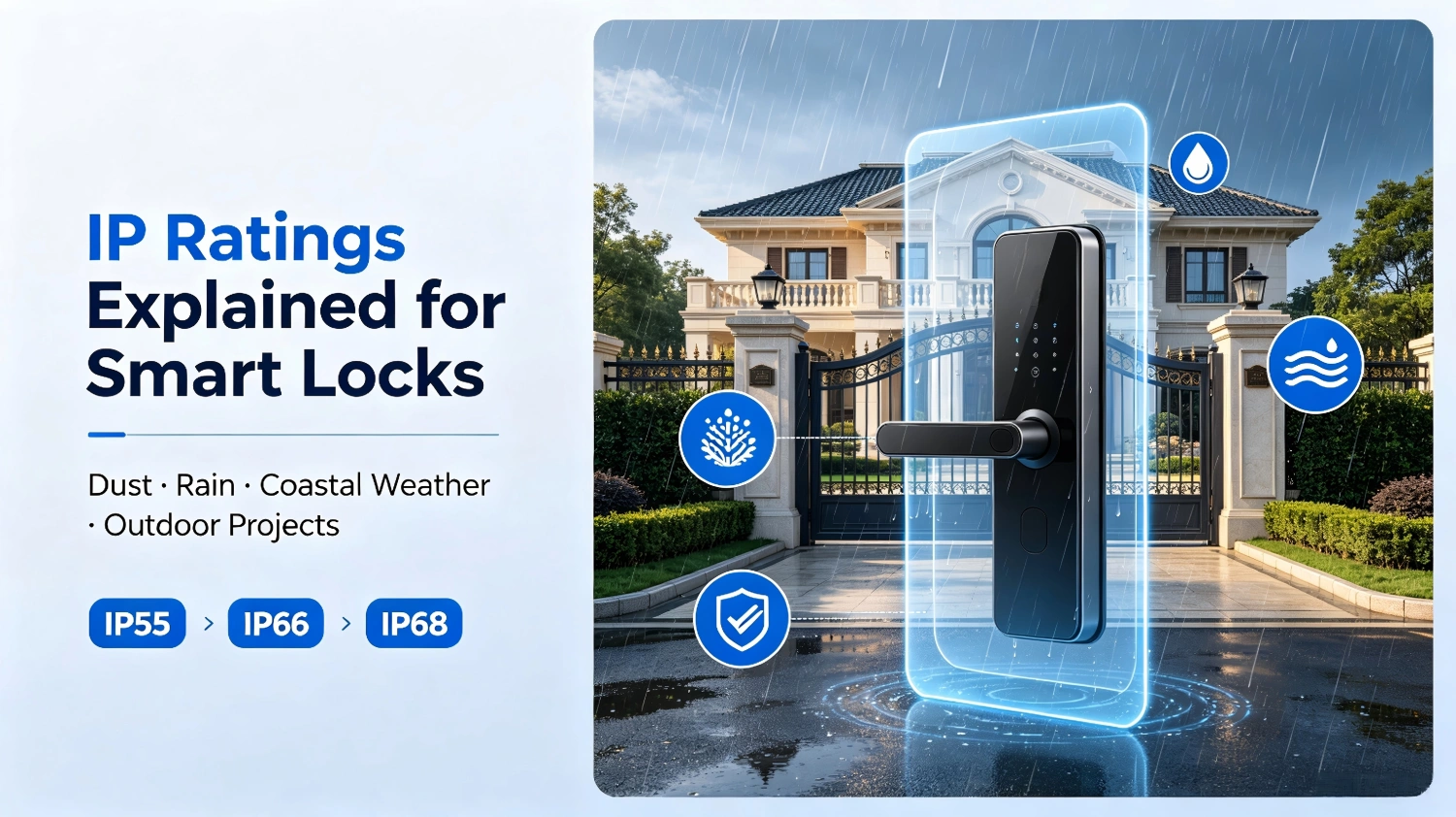
- IP ingress‑protection rating: For outdoor or balcony doors, prioritize models with high‑level IP ratings to resist rain, dust and extreme temperatures. Indoor household locks can be selected according to actual demands.
- Lock body compatibility: Door thickness and lock‑body cut‑outs for European and American markets differ greatly from domestic standards. Confirm whether the product supports multiple lock‑body variants and fits wooden doors, metal doors and thermal‑break aluminum doors.
- Power‑supply solution: Verify battery life and emergency power‑supply interface to reduce post‑sales complaints from end customers.
- Unlocking‑method compatibility: Commercial applications generally require support for passcodes, RFID cards and remote APP management. For hotel projects, double‑check compatibility with mainstream PMS hotel management systems.
- Build‑in material: Stainless‑steel lock bodies and lock cylinders effectively reduce corrosion risks and extend service life.
Beyond product performance, distributors should also assess the manufacturer’s production capacity, spare‑parts availability and technical after‑sales support. Qualified smart‑lock suppliers provide complete certification documents, installation drawings and multi‑language user manuals to resolve implementation obstacles for overseas clients.
Verifying specifications and compliance at the preliminary sourcing stage is essential to lower repair rates and safeguard brand reputation.